
In Summary
- Usually, no — a properly installed low-voltage system is built to run through normal rain and thunderstorms without being switched off.
- The real exceptions are narrow: flooding or standing water near the transformer, visible damage, a GFCI or breaker that keeps tripping, or downed power lines nearby.
- Lightning-driven power surges — not rain itself — are the actual risk to guard against, and correct transformer placement, waterproof connections, and professional installation are what make a system genuinely storm-resilient.
Usually, no. A properly installed low-voltage landscape lighting system is built to run in the rain, and normal storms aren’t a reason to go out and switch it off. The exceptions are narrower than most homeowners assume: flooding or standing water around the transformer, visible damage to a fixture or wire, a breaker or GFCI that keeps tripping, or downed power lines nearby. Outside of those, the system is doing exactly what it was designed to do.
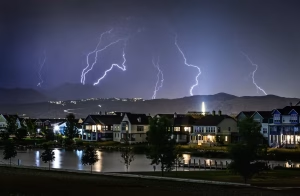
Should You Turn Off Landscape Lighting During a Storm? Not usually, but it depends on the type of storm.
Why Rain Isn’t the Problem You Think It Is
The confusion usually comes from thinking about landscape lighting the way you’d think about an appliance plugged into a wall outlet. It isn’t wired that way. A transformer steps household 120V current down to around 12V before it ever reaches a fixture in the yard, and that transformer plugs into a GFCI-protected outdoor receptacle, which is required by code specifically because it’s exposed to weather. The low-voltage side — the wire, the fixtures, the connectors sitting in wet grass or a rain-soaked flower bed — is a different electrical environment than the receptacle feeding it.
That’s why a correctly installed system holds up to rain without drama. Fixtures rated for outdoor use are sealed against moisture, wire connections are made with waterproof, direct-burial connectors rather than household wire nuts, and the cable itself is rated to sit in wet soil indefinitely. None of that is optional extra protection. It’s the baseline for outdoor-rated equipment. Rain landing on a system built this way is a normal working condition, not a threat to it.
Where that reassurance stops applying is the difference between rain and submersion. A fixture designed to handle a downpour isn’t necessarily designed to sit underwater, and a transformer or outdoor receptacle with standing water around it is a different situation entirely from wet grass. That distinction, rain versus flooding, is really the whole question this article is answering.
Is Low-Voltage Landscape Lighting Safe in Wet Weather?
Low voltage doesn’t mean zero risk, and it’s worth being precise about why 12V systems are the standard for outdoor lighting in the first place. Twelve volts is safer to run through a wet yard than full household current, which is exactly why landscape lighting is built this way, but “low voltage” describes the fixture side of the system, not the whole installation. The transformer itself is still wired directly into household power, which is exactly why its installation, a GFCI-protected receptacle, correct mounting height, a weatherproof cover, matters as much as anything happening out at the fixtures.
A lot of general advice treats “12 volts” as shorthand for “nothing can go wrong,” and that’s not quite right. It won’t shock you the way household current can, but it isn’t immune to a fault. What actually makes a system safe in wet weather is correct installation on both the low-voltage and line-voltage sides, not the voltage number by itself.
So, Should You Turn It Off? A Quick Reference
Here’s the short version, situation by situation:
| Situation | Turn It Off? | Why |
|---|---|---|
| Normal rain | No | The system is built for it |
| Regular thunderstorm | No | A correctly installed system tolerates normal weather |
| Severe lightning, ahead of time | Optional | Unplugging a plug-in transformer beforehand can reduce surge exposure |
| Flooding expected or occurring | Yes | Electrical components can be submerged |
| Standing water near the transformer or outlet | Yes | Keep it off until conditions are safe |
| A fixture is knocked over or damaged | Yes | Wiring or connections may be compromised |
| GFCI or breaker keeps tripping | Yes | It’s likely detecting a real fault |
| Downed power lines nearby | Yes — and don’t approach | Treat the whole area as hazardous |
One important caveat that applies to every row above: don’t go outside during an active lightning storm just to switch off your landscape lighting. If a storm is already underway, your own safety comes first. The system can wait.
The Real Risk Isn’t Rain, It’s Lightning and Power Surges
If there’s a legitimate reason to think about disconnecting a system ahead of severe weather, it’s surge exposure, not moisture.
What Happens to Landscape Lighting During a Power Surge?
A lightning strike doesn’t need to hit a fixture, or even your property, to cause damage. A strike nearby, or a disturbance somewhere on the utility line, can send a voltage spike through anything connected to household power, and the transformer is exactly that connection point for a landscape lighting system.
From the transformer, a surge can travel onward to a timer or app-based controller, and on newer systems, into the electronics built into integrated LED fixtures and drivers, which introduce more sensitive components than older halogen-style setups had. That’s the real reason a storm can take out a system: not the rain sitting on the fixtures, but a surge moving through the wiring.
Can Surge Protection Protect Landscape Lighting?
Surge protection helps, but it’s worth being precise about what it actually does. A surge protector at the transformer, built in on higher-end models or added separately, is designed to absorb or redirect a voltage spike before it reaches the rest of the system, and it meaningfully reduces risk from the more common scenario: a nearby strike or a disturbance on the grid.
What it doesn’t do is guarantee protection against a direct lightning strike to the property, since that much energy can overwhelm most surge protection outright. The realistic goal is risk reduction, not a promise that the system is now storm-proof. Whether it’s worth adding, and at which point in the system, is usually best assessed by a professional as part of installation or an upgrade rather than guessed at after something’s already failed.
When You Should Turn Off Your Landscape Lighting
The exceptions are specific, and they’re worth knowing so you’re not guessing in the moment:
- Flooding or standing water. Rain-resistant is not the same as submersion-proof. If water is pooling around the transformer, an outdoor receptacle, or any line-voltage component, don’t approach it to unplug the system yourself — that’s a job for a professional once it’s safe. If flooding is forecast and you can shut the system down safely beforehand, do it. After flooding, don’t just switch everything back on; have it inspected first.
- Visible damage to a fixture or wire. A fixture knocked loose, a wire pulled up out of the ground, a cracked housing, exposed conductors, a tree limb down across a lighting run, or a washed-out bed that’s exposed cable — any of these means the system should stay off until it’s looked at.
- A GFCI or breaker that keeps tripping. One trip during heavy rain isn’t necessarily alarming. Repeated trips are. That protective device is doing its job by shutting the circuit down when it detects a fault, and resetting it over and over without finding the cause just masks the problem.
- Downed power lines nearby. Stay away from the entire area. Don’t inspect fixtures, the transformer, or wiring anywhere close to a downed line, and contact your utility company.
- A damaged transformer or outlet. Especially after wind-driven storms, falling branches, or flooding, don’t restore power to a transformer or outlet that shows signs of damage until it’s been checked.
Why Transformer Placement and Drainage Matter
An outdoor-rated transformer is designed to live outside, but where and how it’s installed determines how well it actually handles years of storms. A transformer mounted low to the ground, sitting in a spot where water naturally collects, or fed by an outlet without a proper in-use weatherproof cover is carrying more risk than the equipment itself was ever meant to. The same goes for cable buried too shallow, run through a low point in the yard, or routed near irrigation spray that keeps a connection wet long after the rain has stopped.
Why Good Drainage Protects a Landscape Lighting System
Drainage isn’t really a landscaping detail once you consider what it protects. Poor grading near a transformer, a low spot that stays saturated after every rain, or erosion that gradually uncovers buried cable will eventually create the exact conditions that actually matter – standing water and exposed conductors, not just wet ground. A system sited without this in mind can look fine for years and then fail during the one storm that finally tests it.
This isn’t really about keeping every fixture perfectly dry, since they’re built to handle that; it’s about making sure the water a property naturally sheds during a storm has somewhere to go that isn’t through the electrical equipment. That’s a detail our outdoor lighting maintenance guide covers in more depth for ongoing seasonal care; this article is specifically about the storm question, but the two work together.
What to Check After a Storm
Once it’s safe to be outside, a quick walk-through tells you most of what you need to know:
- Look for fixtures that have shifted. Wind, heavy rain, and saturated soil can knock a path light off-angle, loosen a ground stake, or bury a fixture under mulch or mud.
- Check for exposed or damaged cable. Erosion from heavy rain can uncover wire that was previously buried. If you find exposed cable, don’t handle it. Note the location and have it addressed.
- Check for standing water around the transformer, the outlet it plugs into, or any fixture that looks damaged.
- See whether the GFCI has tripped. One reset, once conditions are dry and there’s no visible damage, is generally fine. If it trips again immediately, stop — that’s telling you something, and repeatedly resetting it isn’t the fix.
- Confirm every zone is working normally. Watch for fixtures that are completely dark, flickering, unusually dim, or a whole run that’s out. It’s also worth knowing that a storm-related power outage can reset a timer or controller, so a system that suddenly turns on at the wrong hour doesn’t necessarily mean anything is damaged; it may just need its schedule reset.
- Leave anything wet alone. A visual check is fine. Opening a fixture or handling a connection while it’s still wet isn’t. That’s where a professional inspection earns its keep.
If Your Lights Stop Working After Rain
The pattern of the failure usually points to the cause. If the entire system is out, start with the basics: confirm the house has power, then check the timer or controller, then the GFCI, before assuming the worst. If only one zone or run is out, that’s more often a localized connection, cable, or fixture issue than a sign the whole system has failed. Flickering after rain typically points to a connection that moisture has gotten into rather than a fixture that’s failed outright. And a GFCI that trips every single time it rains isn’t behaving normally; that’s a sign of an underlying fault that’s worth having diagnosed rather than living with. For a fuller breakdown of what causes landscape lighting to stop working and how to work through it, see our outdoor lighting repair guide.
How a Professionally Installed System Handles This Differently
Most of what makes a system genuinely storm-resilient is decided at installation, long before a storm ever shows up. Here’s what that actually looks like, broken down.
Weather-Rated Fixtures and Waterproof Connections
Fixtures selected for the specific conditions they’ll actually face, not just a generic “outdoor” label. A fixture in a bed that regularly floods needs a different rating than one mounted under an eave. Every splice made with waterproof, gel-filled connectors rather than household wire nuts, since connections are one of the most common points of failure in a system that’s started tripping or gone dark.
Correct Transformer and GFCI Installation
The transformer mounted at the right height, in a location that stays clear of standing water, plugged into a properly GFCI-protected outlet with a weatherproof in-use cover. Sized correctly for the system it’s running, since an undersized or overloaded transformer runs hotter and tends to fail sooner, storm or no storm.
Cable Routing That Accounts for Water and Erosion
Cable buried at the right depth and routed to avoid the spots most likely to flood, erode, or get disturbed by digging, rather than taking the shortest path between two fixtures. This is the kind of detail that doesn’t show up until years later, when a “mystery” outage turns out to be a cable that erosion exposed nobody planned around.
Surge Protection
Built in at the transformer where it makes sense for the property, particularly for homes that see frequent thunderstorms, reducing risk rather than eliminating it entirely, as covered above, but a meaningful layer nonetheless.
Maintenance That Keeps Weather Protection Working
None of this is permanent. Seals age, connections corrode, fixtures get knocked out of position, and drainage patterns shift as landscaping matures around the equipment. A system installed correctly five years ago isn’t necessarily still performing to that standard today without a periodic check, which is really what separates ongoing weather resistance from a one-time install detail.
When to Call a Professional
Reach out if the GFCI or breaker keeps tripping, water has gotten into the transformer or an outlet, you can see exposed wiring, several fixtures have failed at once, lights are flickering after a storm, you smell burning or see any scorching, or the system was submerged, and you’re not sure it’s safe to restore power. Those are all reasonable calls to make rather than guessing.
One distinction worth being clear on: downed utility lines or damage to your home’s actual electrical service are a utility company or electrician issue, not a landscape lighting one. If you see a downed line, the right call is to your utility provider, not a lighting technician.
The Best Time to Storm-Proof Your System Is Before the Forecast
A storm isn’t the moment to find out a transformer was mounted too low, a connector was never actually waterproof, or drainage has quietly started sending water toward the electrical equipment instead of away from it. Those are all things a maintenance check catches ahead of time rather than after, which is really the difference between a system that shrugs off the next storm and one that reacts to it.
Protect Your Landscape Lighting Through Every Season
If it’s been a while since your system was checked, or you’ve noticed any of the warning signs above, from a GFCI that won’t stay reset to a fixture that’s shifted after a storm, that’s worth addressing before the next one rolls through rather than after.
Landscape Illumination inspects transformer placement, connections, and drainage as part of routine maintenance, catching the small issues before they turn into an outage or a repair call in the middle of a storm season. A system built and maintained to handle Midwest weather shouldn’t need a second thought every time the forecast changes.
Build a System That’s Ready Before the Storm Hits
Landscape Illumination installs and maintains systems with the transformer placement, waterproof connections, and drainage that actually determine how well a system handles severe weather. Schedule a free consultation or inspection to see where yours stands.